Sunday, 23 December 2018

FT8 - A Rant

I'm going to pin my colours to the mast, I am NOT a fan of FT8!

Sure it's very clever.

Sure it's very popular (that tends to suggest that I am anti-establishment at least ...)

The problems are twofold, as I see it.

Firstly, the mode is so dependent upon computer technology and so non-dependent upon operator skill that it is verging on "frivolous".  Rather like the concept of the "driver-less automobile"

Secontly, it is dragging so many radio operators away from modes which genuinely require operator skill that it's effect as a whole is a negative one.   For example, if, in an emergency communications scenario, (don't forget this is one of the (many) "raisons'etre" of Amateur Radio) the chances are that the internet will not be functional, therefore (as it is dependent upon clock synchronicity for it to work) FT8 would not be a suitable means of communication, clever as it may be.

Sure, there are good things about it - it's sheer popularity has shown that bands which appear to be "dead", are in fact only "dead due to inactivity", and I actually applaud this.  I wish there were a better alternative, but for the moment I can't think of one.

Nevertheless, weighing the plusses and minuses, by my reckoning, it's a Bad Thing.

There, I've said it. 

I accept that it cannot be "uninvented" - the Genie is indeed out of the Bottle.

I will now crawl back under the stone from which I emerged to make this assertion ...

I know, "antediluvian" might be a (relatively polite) term for my opinion, but it is what it is.

Oh well, back to the Pump Handle!

Sunday, 20 December 2015

It had to happen - RoPoCo Contest Dumbed Down AGAIN!

If it wasn't bad enough to change my once favourite twice-yearly short CW contest "RoPoCo" (Rotating Post Codes)  into a CW/SSB contest, the RSGB have now in their infinite wisdom completed the dumbing-down process and changed this into something which is now called "RoLo" (Rotating Locator).
The whole essence of the contest in its original format is that it was a test of both sending and receiving CW skill.
UK postcodes have a slightly quirky format in that the number of letters and numbers in the first part of the code is inconsistent, being either one or two letters followed by either one or two numbers.  The second part of the code (separated on paper by a space) always has a single number followed by two letter.
This made the sending and receiving of the codes accurately somewhat challenging, and part of that challenge is that the SPACING of characters becomes of some importance. (Note that the spacing embedded within the codes when submitted as contest results was never taken into consideration, but receiving a space in the correct place encourages the receiving station to feel that he may or may not have copied the code down correctly)
You may have read elsewhere that the SPACING of CW is one of my pet hobby-horses, as one of the main quality defects of a great many CW operators in my opinion is that their spacing is abysmal, assuming there is any spacing at all.
Perfectly formed characters can be rendered fairly unintelligible (especially when reading the code in one's head) by poor or non-existent spacing.   Conversely, less-than-perfectly-formed characters when spaced correctly should cause the experienced CW operator no difficulty in decoding.
So now we have a CW contest (at least one of the two segments of this contest is for CW operators) where the desirability of good spacing has been eliminated by replacing "quirky" alphanumeric postcodes with monotonously regular Maidenhead locators in their strict format of letterletternumbernumberletterletter (forgive my spacing ... !)

Sunday, 13 April 2014

Don't Turn it On, Take it Apart (a homage to EEVBlog)

Don’t Turn it On, Take it Apart!

So says Dave L Jones, the man behind what I think is the best channel on YouTube, EEVBlog.

If you haven’t paid EEVBlog (which stands for Electronic Engineering Video Blog) a visit yet, you simply MUST.

Dave is (inter alia) an experienced electronic design engineer turned full time Video blogger who happens to live in Sydney, New South Wales Australia.  

 He’s passionate, entertaining articulate, knowledgeable and opinionated, and above all as “Australian” as they come, and rightly proud of it.

His video blogs cover a wide range of subjects including equipment reviews (Dave seems to have a Test Gear fetish!) “teardowns”, tutorials and rants.

His approach might be regarded as rather brash by some, and his language occasionally becomes slightly “colourful”, but I find his no-nonsense-tell-it-like-he-sees-it approach extremely refreshing, and not agreeing one hundred per cent with everything he says is just part of the appeal.

Introducing a “Fair Dinkum Flying Pig”

As an appetiser may I suggest the following viewing for your maximum entertainment?

EEVBlog #39 – Microchip PICKit 3 Programmer Review

Microchip Response to PICKit 3 Review from EEVBlog #39

EEVBlog #41 – Pigs fly at Microchip

Dave admits in his 500th episode – a 5 hour “live” show, when asked by one of his online chatroom colleagues that this series are amongst his own particular favourites of all the shows he has done.

As the man says : “check it out”!


Sunday, 16 February 2014

After the Storm (s) - "Wind Pruning"?

Like a lot of folk here in the U.K. I've been outside catching up with some property maintenance during what appears to be a welcome break in the long sequence of Atlantic depressions we have been suffering from lately.

Fortunately for me (I do not wish to appear selfish but I can only state the facts, as I see them!) in my part of the world, North West England, we appear to have got off lightly compared to our our countrymen in the Southwestern corner of our island, so my "property maintenance" is basically the cosmetic job of tidying up the detritus left by recent storms using a stiff broom and a manual spring lawn rake.

What has been interesting to me is that whereas I have been used to raking and sweeping up last  year's leaves deposited by the wind, nearly all from neigbour's trees and not my own (such is life!), on this and recent occasions, this "detritus" has actually been in the form of small twigs as much as, if not more than dead leaves.

This has caused me to ponder whether, assuming that the weather eventually returns to something like normal, this
    wind pruning
of the trees will ultimately reap some benefit.

Mother Nature has a habit of being very resilient to disturbances in the normal scheme of thing - the regeneration of woodland following forest fires is perhaps a classic example of this - so I wouldn't be all that surprised to see renewed and vigorous growth when the warmer weather returns in a few weeks' time.

If the weather pattern steadfastly refuses to return to anything like "normal" then all bets are off, of course!

Saturday, 25 January 2014

"Misleading" is the politest term I can think of to describe this . . .

For more years than I care to remember, I have been a user of the old "Norton File Manager" application in its various guises (e.g. it was packaged as part of Norton Navigator some years ago).  Back in the days of DOS I used XTREE a lot, and "NFM" seemed to be the logical progression from that.

Now, I have to admit, NFM's days are numbered as it doesn't work reliably under Windows7 - it keeps on crashing with "Smartheap" errors.  Upon look for an alternative I came across something called "WinNC" which purports to be a "Windows Norton Commander Clone".

There was a "try before you buy" download available so I thought I'd give it a go.

Frankly it's far more flashy and cumbersome than NFM ever was, but it seemed to work reasonably well, and eventually I felt tempted by the popup splash screen you get when you start the application :-


Consequently I decided to have a little look at the purchasing options, as just less than 20 Euros was quite tempting.

Upon following the link what I was presented with was this :-

. . .which got me somewhat annoyed!

Trying an alternative route and looking at the GB Pounds options produced this :-

. . . so I really don't think I'll bother, in fact I think I'll uninstall it and look for something else!

I understand perfectly (thinking of a famous quotation my Mark Twain) that taxes are unavoidable, but that isn't the point here.

Which as a shame really, because at the price quoted in the application splash screen I was sorely tempted.

Tuesday, 24 December 2013

A (Christmas) Magic Smoke Event . . .

I have recently been giving one of my "old ladies" in the guise of my 1982 vintage FT-101ZD Mk3 a "run out", promoting it to "main station rig" status for a few days despite the fact that I am aware that it is still in far from perfect working order.

It's basically a nice set, so that was no major sacrifice.

However, after the radio had been on for a few hours I suddenly started to get a distinct smell of "something" from it. I've smelt very many electronic faults in my time, but this one seemed rather to smell of a pan on the stove burning dry, but I quickly realised that there was no pan on the stove in the kitchen, and that the smell was indeed coming from my '101.

I removed the power and found a flashlight so I could investigate the cause, and spotted a little plume of smoke emanating from the left hand rear of the rig, and I also noticed that this corner of the rig seemed to be rather warmer than normal.

Straight away I disconnected all the external cabling, and, having allowed a reasonable time for the internal high tension power supply to discharge, I removed the top cover thinking that the sooner I could get at the innards, the more likely I was to identify the source of the problem.

Thus I homed in on the "Rectifier B" board and quickly spotted a rather distressed looking electrolytic capacitor which also seemed to be unusually warm to the touch.

Rectifier B Board in situ - PB-1968B

Now it may be recalled that this radio, bought originally as a “spares or repair” item from EBay, has had a chequered history having done questionable service as a high powered and illegal CB rig. It had no doubt been abused, quite possibly by someone less educated in the finer arts of the tuning and conservation of valve/hybrid rigs, this abuse being most keenly felt by the power supply stages. I had already rebuilt the “Rectifier A” board which had expired completely, and it now appears that I should have paid rather more attention to the “Rectifier B” board, which supplies screen and grid bias supplies to the output stages.

My own fault and hopefully any collateral damage will be minimal.   Looking on the bright side, as one of my “Twitterati” so nicely put it, at least it was “Christmas Magic Smoke”!

Saturday, 21 December 2013

Microsoft Windows 7 - Gain without much Pain . . .

With the impending end of Microsoft’s support for their venerable and very successful Windows XP, I had been wrestling with the relative benefits of either “upgrading” my existing main desktop PC to Windows 7, or replacing it entirely, with the risk of having to put up with the almost universally reviled Windows 8.

I had been using Windows 7 on a  borrowed PC for some time and had become relatively comfortable with that environment, and so decided to take the plunge and go down the “upgrade” route with my 7-year old, reasonably specced (for its time) machine.

I purchased a copy of Windows 7 Home Premium from a seemingly reputable (according to the feedback) EBay supplier  and a brand new hard drive from EBuyer.com ( the thinking there being that there was an easy route back if the Windows 7 installation proved to be a disaster).

I have to say that the whole business went surprisingly well right from the initial minor surgery to replace the primary hard drive on my PC, which even included a vacuum out of the dust, cobwebs and general detritus which had accumulated in the last 12 months since I last had the machine apart.

The Windows 7 installation itself went very smoothly, the most anxious moments being those during which I waited with baited breath to see if my 25-digit licence code would be accepted (it was!).

I am not a player of games, apart from the “normal secretarial duties” of EMails, web surfing and writing documents, my machine spends most of its time running fairly esoteric Audio Spectrum Analysis DSP software associated with my hobby of recording “radio meteors” so the amount of software I had to re-install was relatively small.   Everything I installed worked pretty well without any problems and here I am a day later with a machine with a completely new operating system installed running every program I use regularly, consequently I am as “Pleased as Punch”.

The only downside is that of the new Microsoft Office 2013 which I have had “in stash” for a while ready to be installed on a Windows 7 (or later) machine.   This has appears to have been designed to have a “Windows 8” look about it, and frankly it’s horrible to look at.  I felt obliged to install this heavyweight package due to it (a) being cheap due to an arrangement my employer has with Microsoft, and (b) there is no built-in EMail client in Windows 7.  

I could of course opted for something like OpenOffice with Mozilla Thunderbird, but I had the Office install disk already.   Maybe more on that later, but at the moment I am struggling to find any nice words about Office 2013, but I should probably give it more time before I put virtual pen to paper!  It appears to work fine, but it just looks DREADFUL.   That’s a great shame as one of Windows 7‘s greatest appeals is that it “looks nice”, to me, anyway . . .

Sunday, 12 May 2013

Icelandic Meteor Reflections - Channel E4


The purchase late in 2012 of a "FunCubeDongle Pro+" opened up a new world to me - those parts of the "Low VHF" spectrum away from the amateur bands, or to be more accurate, away from the amateur 6metre (50MHz) band.

Very soon I homed in on a "new" target for meteor reception of the Skalafell TV transmitter in Iceland. This transmitter is allegedly due for closure at some point in 2013 as part of the Europe-wide "Digital Switchover" so I was naturally keen to make use of this before the big switch-off. I quickly found that it was an excellent target for meteor reflection reception, being at more or less the optimum distance away, high power (presumably) and on the air (as it turned out) 24/7.

This year's Eta Aquarid meteor shower coincided with a public holiday which meant that I wasn't working and therefore was able to pay pretty close attention to the "goings on" on all my meteor targets, and it wasn't really a surprise when I started to get some pretty impressive results on this channel (E4 - 62.25MHz).


 However, what was a surprise was the realisation that I was receiving TWO signals, the second and surprise one being a few hundred Hz below the main one.

What was really interesting to me was the similarity in some ways and difference in others between the characteristics of the received signals.

There were many occasions when coincident reflections were received, and others when there were completely separate reflections.

Similarity suggests that the two sources are relatively close together, and difference suggests that they are not _that_ close.

At the moment I am working on the assumption that they are both from Iceland, but possible in geographically separate parts of that country.

This has been further supported by a more "normal" spell of observation today when meteor activity is at a "normal" level, and, with this being early summer, some tantalising hints of more exotic propagation modes, namely "Sporadic-E". Again I have seen many examples of "co-incident" reflections (Sporadic-E ones seem to be co-incident in general), and non co-incident ones.


According to the "G0CHE" Band I TV information web page there are indeed two (suspected) Icelandic TV transmitters on channel E4, though the frequencies quoted on that site don't quite stack up with my own observations, unless the "new" signal is really Skalafell, and the one I have been referring to as Skalafell is actually Gagnheiði.

Any help in unraveling this mystery would be appreciated!

Sunday, 5 May 2013

Adlestrop (a short poem by Edward Thomas)

People who have the dubious honour of knowing me personally know that I am most certainly not an "arty" kind of person.

OK I play music semi-professionally in a "ceilidh band", and have an eclectic taste in music, well I think I have anyway,  but other forms of "high art"  (visual and the written word) are a mystery to me.   My taste seems to be very unsophisticated in comparison with that of others.

I mean, a picture should _look_ like something, shouldn't it?  I'm an engineer by profession, I believe in Ohm's Law!

However Damien Hirst makes far more money than I do, so I guess I'm the one in the wrong.

But perhaps by way of proof that I am not a complete Philistine, here is my favourite poem.

It's very short  but it evokes such imagery in my imagination that it astounds me in its brevity and seeming simplicity.  I never tire of reading it.

Adlestrop

Yes, I remember Adlestrop --
The name, because one afternoon
Of heat the express-train drew up there
Unwontedly. It was late June.

The steam hissed. Someone cleared his throat.
No one left and no one came
On the bare platform. What I saw
Was Adlestrop -- only the name

And willows, willow-herb, and grass,
And meadowsweet, and haycocks dry,
No whit less still and lonely fair
Than the high cloudlets in the sky.

And for that minute a blackbird sang
Close by, and round him, mistier,
Farther and farther, all the birds
Of Oxfordshire and Gloucestershire.

Friday, 3 May 2013

High Altitude Ballooning

For a little while now I’ve been fascinated by the hobby of “High Altitude Ballooning“.
It’s such a short while that I can’t yet claim to be an expert in that subject, but what I have seen has really sparked my interest and imagination.

I stumbled on a page on the  "Raspberry Pi" web site, and it turned out that the "Pi" and ballooning have been bedfellows for quite a while.    Furthermore it seems that the BBC's James May (Man Lab) and Channel 5's Gadget Show  have have featured balloons, but as someone who rarely watches TV (even more rarely now Time Team has been axed!), this has only recently come to my attention.

This particular activity, and the background to it appears to pull together a number of disciplines, and it’s the amalgamation of these which has really got me excited.

Once I discovered, almost by chance that the telemetry transmitter from HABs (High Altitude Balloons) could be received at my modest radio station from a distance of 200+ miles I realised I could participate in this activity, even if I never actually went near a balloon.

Even more exciting was the realisation that many of the participants in this activity sre relatively young people.    I've long felt that it is high time that the younger element of our population took up the baton of technical innovation and put those of us of the “older generation” firmly in our place.

It’s not exclusively the dominion of the young, but there appear to be proportionally more of the younger generation taking part than say in “vanilla” Amateur Radio.

Great!

Here are a few web links to enlighten you further, if you are interested :-

UK High Altitude Societywww.ukhas.org.uk

SpaceNear Online Tracker (Google Maps based application) -  spacenear.us/tracker
Note that ballooning is popular on the Continent as well as in the UK, especially in Poland.

StratoDean – a fabulous blog maintained by participants from the Forest of Deanwww.stratodean.co.uk

Balloon flights tend to take place at weekends when the weather is favourable.  “Weather” doesn’t just mean what the weather is like at ground level, but also what the winds are doing in the stratosphere as these balloons usually achieve an altitude of over 30,000 metres (yes, 30km!), and the participants aren’t too keen on flight predictions which end in either the sea or in foreign countries!


 The above graph lifted from the spacenear.us online tracking application shows the flight profile of a recent flight and clearly shows what is likely to be achieved in terms of altitude and duration.

A flight in the south of England becomes audible to my station in the north of England once it gets to around 10km in altitude, and the telemetry  transmissions are generally decodable throughout this phase of the flight.

Telemetry is transmitted from the payload using small proprietary low power transmitters which happen to use part of the amateur "70cm" band, which is basically where we radio amateurs come in - many of us have high specification equipment and aerials capable of receiving these transmissions.   In my case I use my trusty Diamond dual band (2m/70cm) co-linear and my FunCubeDongle ProPlus SDR, see below.


The above picture is a composite (ie more than one image has been stitched together to make a single image) screen grab of  a “Spectrum Laboratory” screen and shows in graphical form the strength of the signal from the “Stratodean1″ flight from around 0945 UTC until about 11:30 UTC when the signal was finally lost as the payload descended under its parachute.  NOTE: The sudden “steps” in the display were caused by me adjusting my receiver to get the signal “centered” in the passband of the display, and were not caused by a problem with the payload telemetry transmitter!

Just to give you an idea of how remarkable radio transmission are above 10km, note that the transmitter power is 10mW, and the aerial on the payload is a simple ground plane affair made by using a length of stripped back coaxial cable and drinking straws!   See the StratoDean web site for more information about this and other technical details about the payload.

The screen grab below shows the flight profile for StratodeanOne and I've marked it up to highlight the part of the flight I was able to receive in Penrith (IO84 square).


Saturday, 24 November 2012

Wind-up Torch, what a Wind-up!

Don't get me wrong, this really isn't important, but I have to say it did make me chuckle at the sheer irony and cheek!

Some time ago, and I can't for the life of me remember when, and it doesn't matter anyway, I bought a "Wind-up Torch" from a supermarket chain - ASDA  I think, though I certainly wouldn't swear to it.

Frankly I was never very impressed with the performance of it from the day I bought it.

As I understand it, with a wind-up torch, one was supposed to crank the handle like billy-o and then one would have a usable torch for a while afterwards.

Well this thing I bought was never any good, any light after the cranking was short-lived, and if one wanted a steady light, one just had to keep on cranking steadily away which kind of defeated the object.

Anyway, as it was very cheap I never really got "wound up" (sorry!) about the problem, and kind of put it down to experience, as one does.

Anyhow, the day came when the thing finally refused to work AT ALL, and I decided to dispose of it, but being one who gets a bit of a kick out of recycling electronic components in home brew projects, I decided to disassemble it before I disposed of the the remainder.  So out came the jewellers' screwdriver set.

Very soon after starting the dismantling process I spotted something rather odd - a lithium battery.


Why did my wind-up torch have a battery in it, and, frankly, not much else?

The attached photos show what I found :- a small "generator unit", a pcb with a lithium battery, some diodes, one small SMD capactor, a switch and three LEDs.

As soon as I saw this little collection, I smelled a rat!   Surely, I am going to find that the battery is flat (thus explaining the lack of light), I thought.  Guess what?   Flat as a pancake!  No surprise there . . .

I shall leave it to the reader to work out what can be done with :-

(a) a small electromechanical hand-cranked generator

(b) a dpco switch

(c) about half a dozen small rectifier diodes

(d) a 100nF capacitor

(e) Three white LEDs

(f) A coin (lithium) cell

(g) some small reduction gears  . . .


Wednesday, 28 March 2012

Electronic Experimentation (Spiralling Off . . .)

I wish now to relate something of the pleasure which can be experienced whilst carrying out simple experiments.

The Nutty Professor is at it again ! ! !


As many who experiment with home construction would no doubt relate, one thing quite often leads to another, which in turn leads to another, and so on (or to misquote a line from the "Commitments" movie - they go "spiralling off").

It's a wonderful thing on the whole, but one of the frustrations with it is that one never seems to get anything quite finished!

Readers of earlier blog entries will have spotted references to crystal controlled transmitters and receivers for use with the QRSS aspect of the amateur radio hobby.

Successful (one hesitates to say "the best" as this implies some sort of competition, and I don't think QRSS folk are particularly competitive) QRSS stations, whether simple or complex have to be well engineered.

Sloppy engineering practice soon becomes evident, manifesting itself in unreliability or in poor performance, and the poor performance I am thinking of in particular is that of frequency stability, or rather the lack of it.

My own home made efforts have exhibited acceptable, if not outstanding stability, and one quickly looks to ways of improving performance.

For some time now I have been pondering this issue, and a chance visit to a rather interesting web site produced a nicely written article explaining how to make a simple crystal heater
.
Thermostatic control of the temperature of the crystal used to produce the QRSS signal, or local oscillator in the case of a receiver seems to be a fairly obvious thing to do, and I had already looked at a commercial offering which offers high stability for a few pounds, and is a microcontroller based solution.

The heater to which I am referring though is a much simpler affair using a darlington transistor to modulate the flow of current through some low value resistors (the heating elements), with a thermistor to provide regulation and feedback.

This struck me as a brilliantly simple idea, so I resolved to build something similar if not quite identical.

With the exception of the thermistor, all parts came out of my junk box, in fact the darlington transistor was concocted from a small power transistor rescued from some long-forgotten project (the leads had been cut and had traces of old solder on them) and a low power Japanese 2SC something-or-other freshly removed from a scrap board which was probably a transistor radio or portable TV 20-odd years ago. Total cost of parts, probably quite a bit less than a pound.

The crystal being thermally controlled (heated) is physically but not electrically connected to a heated piece of thin tinplate (formerly part of a screening can also rescued from a scrap board).

When connected up to a power supply, my little heater worked first time (it is so simple it could hardly fail), and after some experimentation with the settings I had it heated up to just under 40 deg C, and was able to adjust the crystal FREQUENCY (the crystal was electrically connected to a completely separate test oscillator) by tweaking the temperature of the heater. The heater once it reached equilibrium maintained its set temperature perfectly.


My test set up involved monitoring the current drawn by the circuit, and the collector voltage of the transistor.

Pretty it ain't - interesting it certainly is!
Inspection of the circuit shows that they go in opposite directions - when the collector is high, the current drawn (and therefore the power being dissipated in the heater resistors) is low, and vice versa. If the surroundings change, or the circuit is heated up or cooled down deliberately the circuitry compensates for the changes very quickly thus restoring equilibrium.

One quickly realises that this little heater is really trying in its own small way to regulate the temperature of the
whole planet, and for it to be as economical as possible, it needs to be thermally insulated as much as possible from the outside world, and a little more thought reveals that in a way this little circuit is a miniature representation of, say, a domestic dwelling where the occupants try to maintain a comfortable temperature inside when the weather may be up to all sorts of tricks on the outside.
The heater schematic


Fascinating.

Also, as I have an interest in the application of microcontrollers, this application is also, as stated above, one where a microcontroller could be used, but this is where one needs to think about cost. Even buying new components, the unit cost of my little device would be no more than a pound, and the cheapest microcontrollers cost in the region of 75 pence per unit, so by the time you've bolted any additional components required, the simple version probably wins out, but only just. Die hard microcontroller enthusiasts would probably dispute that assertion!
Either way the mere consideration of one approach versus the other illustrates perfectly how experimentation can lead one through all sorts of interesting thought processes, which is really the whole point of me writing this note.

Saturday, 25 February 2012

The Mad Mad World of Microcontrollers

It's been a while since my last blog, and that has been bugging me to the point where I feel I have to "tick the box" and "blog SOMETHING", so here it is.

The last entry was made shortly after I'd "discovered" the Arduino system, and this discovery has let me spiralling off into all sorts of strange directions, all associated with microcontrollers, one way or another.

In the meantime I've bought what I think is a rather good book called "The Quintessential PIC Microcontroller" by Sid Katzen which deals with the subject manner in a way which resonates with the way I approach things.   Recommending books is a dangerous business, rather like recommending restaurants or wines or other things which are extremely subjective in nature, so all I will say is that I think it's rather good and leave it at that.

I've also acquired a few bits and bobs associated with Atmel AVR microcontrollers (an Atmel AVR is at the heart of the Arduino), namely a "TinyUSB" programmer, a few low-end microcontrollers, an LCD panel, and I've just downloaded the AVR Studio IDE package from the Atmel web site.

Buying expensive text books apart (I only have a couple of microcontroller books, honestly!) the best way to "learn microcontroller" is by doing stuff, so that has now become the prime objective.

I should relate the story where my eyes were opened about the desirability of using microcontrollers.  This was when I was participating in a Radio Club project to scratchbuild a 70MHz transceiver (The Eden 9 Project) and had got to the point where working IF strips were emerging from our group of constructors.

The IF strip had been deliberately designed without an AGC system, but with the facility to add AGC later, and a prototype audio-derived AGC system was duly demonstrate.

Now some people are rather "sniffy" about audio-derived AGC - I may or may not have been one such sceptic, I couldn't possibly comment! - but this demonstration was remarkable!   Not only was the performance of the circuit so impressive, but the parts count (and cost) was so low!  

Of course, as I am sure you have worked out already, there was a PIC microcontroller at the heart of this little add-on board, and when one stops to consider how the "all analogue" alternative might have been designed then it doesn't take long to realise that the alternative would be more complex, costly and less flexible.   With a microcontroller prototype, just changing a few numbers inside the embedded program is the way performance is tweaked.  To cap it all the PIC at the heart of this unit retails at around a pound at time. Good value, or what?

All I need now is the time, willpower and inspiration to get down and learn the ropes properly.

Sunday, 22 January 2012

New Year, New Ideas (or not!)

I don't think I am capable of "Original Thought".

Every time I think I have discovered something new, I realise that I am re-inventing the wheel.

Please don't think I am bitter about this, if I have a philosophy in life it would be a misquote (no blasphemy intended!) of one of the "Ten Commandments" (or to be more specific the Tenth Commandment) in that I do not (or at least try very hard not to) covet what another has.

Wives, possessions, original ideas, it's all the same thing to me!  Coveting like resistance (misquoting the Borg this time) is futile.

A couple of weeks ago, a professional colleague who works at our Head Office, unlike me who works "out in the field" mentioned something called an "Arduino" to me, and I had to confess that I'd never heard of it.

Anyway, to cut a long story short I looked "Arduino" up on the web, got very excited (!) at what I saw, bought one, faffed about with it and began asking friends and other colleagues if they knew about this wonderful piece of gadgetry, and it seems that I was the only one who thought it was something "new"!

Largely thanks to my friend and mentor, Ron Taylor (G4GXO) of Cumbria Designs, I had been introduced to the world of microcontrollers some little time ago, in connection with the "Eden 9" project.  For those who don't know, the Arduino is essentially a "mini microcontroller development board" based around an Atmel microcontroller, and as such could be described as a "microcontroller on steroids".

Further research, and reading of other bloggers' output revealed that Arduino isn't the only contender in this market place, Julian,  G4ILO has blogged about the "Gadget Gangster Propeller USB" platform, which seems, at least to the casual observer to be more or less the same thing but done with different hardware.

The unfortunate thing for me is that I now have ANOTHER interest to compete for my limited free time with QRSS, meteor observations, Digimodes, Classic Rigs, etc etc.   If only I could afford to retire from the Day Job and play with all these new toys!

Sunday, 11 December 2011

RC-14 - An Old Project Revisited

Way back in June 1987, the RSGB published an article in RadCom describing the "RC-14", a relatively simple "beginners" single band (20m) direct conversion receiver.    This was "kitted" by the then popular "Cirkit" emporium, and was offered at an attractive price to RSGB members.

This was, in my view a very well designed piece of equipment, and contained only three integrated circuits (one of the famous and rather splendid Plessey "SL" ICs and a couple of op amps configured as active filters with characteristics very similar to those of a high-performance crystal SSB filter) plus a varactor-tuned VFO, and the end result was a very pleasing receiver.

I built the receiver not long after it was published using the approved kit, and adapted it to my "bespoke" requirements - I disliked the flimsy enclosure provided and moved it to a more mechanically sound but less aesthetically pleasing aluminium die-cast box, and replaced the linear slider tuning pot (remember it was a varactor based design) with a rotary multiturn unit, albeit at great expense, and used it for a while (as you do) and moved on . . .


My version of the RSGB RC-14

Recently, I have become interested in the "QRSS" aspect of the hobby which is based around the transmission of very low power, low signalling rate beacon signals for extended periods which are received at various locations around the globe using PC-based "grabber" software.

Participation in this requires either the setting up of a "grabber" receiving station, or the use of a low power "MEPT" (Manned Experimental Propagation Transmitter), or in some cases both, though not necessarily at the same time!

Over the last few weeks I have been doing either and even occasionally both (!) using conventional equipment, and by "conventional" I mean "High Performance Japanese Transceivers", certainly as the receiving station, but it occurred to me recently that it was possible overkill using such high-spec equipment to perform such relatively mundane tasks.   In a flash of inspiration (or something!) I remembered my RC-14, and began to wonder if that could be dragooned into service as a QRSS receiver.

The built-in VFO, though adequate for general receiving purposes was certainly not of the required specification as a QRSS receiver, where frequency stability is a primary requirement, but the substitution of the built-in VFO with a crystal-based, or even synthesiser-based local oscillator would seem to be a Good Idea.

If you are following the argument, then by now you will surely have picked up on the mental thread . . .

And so, another project is born!

Sunday, 27 November 2011

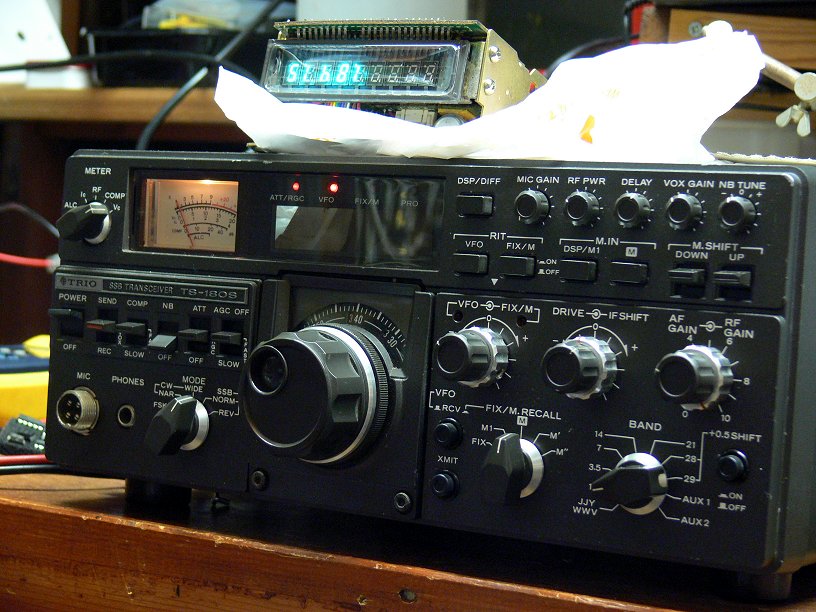
TS-180S - this is getting ridiculous!

I knew it was a mistake putting the lid on properly.
Having restored the functionality of the frequency display I decided to run the radio for a few hours over the weekend to evaluate performance further.   Still no tx, of course or any PLL locking on 28MHz but I knew that already ...
I was listening to a QSO on 7MHz this morning between a very strong Belgian station and a string of UK stations, most of whom I could hear reasonably well when I realised that the frequency seemed to be locked on to 7.150.0MHz.  Tuning either side by a kHz or two made no difference to the display.   I had a funny feeling about this, so I tuned up and down the band to find that lo and behold that the display was only displaying frequency to a 10kHz resolution!
To see whether this was a heat related issue I switched the radio off and let it cool down for half an hour or so, but on re-powering the fault was still present, so I have concluded that I have ANOTHER dead chip!  More than likely a duff 7490 in the counter chain, and that's TTL not CMOS, so another theory goes down the pan.
It is now only sheer stubbornness which is sustaining my interest in this project.  In all the years of building and repairing equipment, I don't think I've ever come across a project like this.   Trying to fix up a radio with numerous faults is one thing (and what I thought I was dealing with here), but fixing one which keeps breaking seemingly randomly whilst under repair is quite something else.   It's a case of either "nolum illigitimus carborundum", or chuck the bloody thing in the (recycling) bin!  I don't give up easily though.  What kind of trauma has this radio suffered in the past?   It's anybody's guess.

Saturday, 26 November 2011

TS-180S Display Fixed (Again!)

As I reported previously I discovered that the display in my TS-180S which is currently undergoing major restoration was again faulty.

The symptoms were either that it displayed just the "base" frequency of the band in use when it was powered up, "1.500.0" for example on Top Band, "3.500.0" on 80m, or another sequence of numbers unrelated to anything.  None of these numbers changed when the bandswitch was operated with the set switched on.

A couple of nights ago I decided to have a look with my test gear to find out what was going on, or not.

The trickiest part of the whole operation is extracting the display from the radio, and conversely refitting it after investigation, and this struggle led me to suppose before I started that the fault was induced during the arduous refitting after the previous repair, and the consequential tidying up of the cable harness.

This was soon proved not to be the case as investigation with an oscilloscope quickly led me to the conclusion that (a) there was plenty of 40-40.5 MHz signal from the premix unit but (b) there was no gate signal in the digital counting chain.

So attention returned to the previously repaired divide unit which sits underneath the main counter board, and so consequently the whole caboodle had to be extracted once again from the radio so I could get at it.

Well at least I was well practiced at this, and knew what to do (familiarity doesn't imply enjoyment!), so eventually, after cutting some of my nicely installed cable ties, and much cussing, I had the recalcitrant unit upended so I could investigate.

TS-180S Display Divide Unit
The marked up drawing above shows what I found, and I quickly came to the conclusion that either Q8 or Q9 would appear to be faulty, with the balance of probabilities suggesting Q8.
 
Fortunately a trawl through my spare parts revealed that I had a 4013 (Dual D-Type Flip-Flop) and also a 7400 if required, so I had a "cunning plan" to replace these parts in the radio the following evening.


Divider Board - Q8 Bottom Right
 
And so it came to pass.  The following evening Q8 came out as sweet as a nut (it was helpful that it was in the corner of the board and no immediately surrounding components, a new 14-pin turned pin socket was soldered in and the new chip installed.
 
Powering up the radio followed and to my great delight the correct frequency display appeared!  Yay!
 
Display Correct (note - upside down!)

Display ready to go back in ...

The display has now been refitted and is working as I type this, so after much effort, I am now back where I started and wondering (a) what on earth will go wrong next? and (b) how can one radio have had so many seemingly unrelated faults?    The only connection I can think of between this fault and the previous repair to the divide unit is that both of the faulty chips were CMOS types of presumably similar vintage?  Maybe the anti-static handling precautions at the factory weren't up to much at the time?
 

Faulty Q8 - Innocent Looking, eh?